
Water is a critical resource in almost every industry. From food and beverage production to energy, chemicals, pharmaceuticals, and electronics, the quality of process water directly impacts product quality, process reliability, maintenance costs, and the lifespan of installations. Reverse osmosis (RO) is therefore a widely used technology for purifying water and making it suitable for industrial applications.
What is reverse osmosis?
Reverse osmosis is a membrane technology that removes the majority of dissolved salts, minerals, and other contaminants from water. The technology is used in a wide range of industrial applications, from process water and boiler feed water to ultra-pure water in combination with additional post-treatment.

How does reverse osmosis work?
In reverse osmosis, water is forced under pressure through a semi-permeable membrane. This membrane primarily allows water molecules to pass through while retaining most dissolved salts, minerals, organic compounds, and other contaminants.
The result is:
- Permeate water: purified water that can either be used directly, depending on the application, or undergo further treatment.
- Concentrate: a concentrated waste stream containing the rejected salts and contaminants, which can be discharged, reused, or further treated.
To achieve stable performance, RO is almost always combined with suitable pretreatment. This may include filtration, softening, activated carbon filtration, pH correction, antiscalant dosing, or disinfection control. These measures help limit scaling, fouling, biofouling, and premature membrane degradation.

Why pretreatment is crucial
An RO system only performs as well as its pretreatment. Parameters such as suspended solids, SDI, hardness, iron, manganese, organic load, microbiology, chlorine, and temperature determine how quickly membranes foul or degrade. A properly engineered system therefore takes into account not only the desired permeate quality, but also membrane lifespan, recovery rate, energy consumption, cleaning frequency, and operational costs.
How is an RO system built?
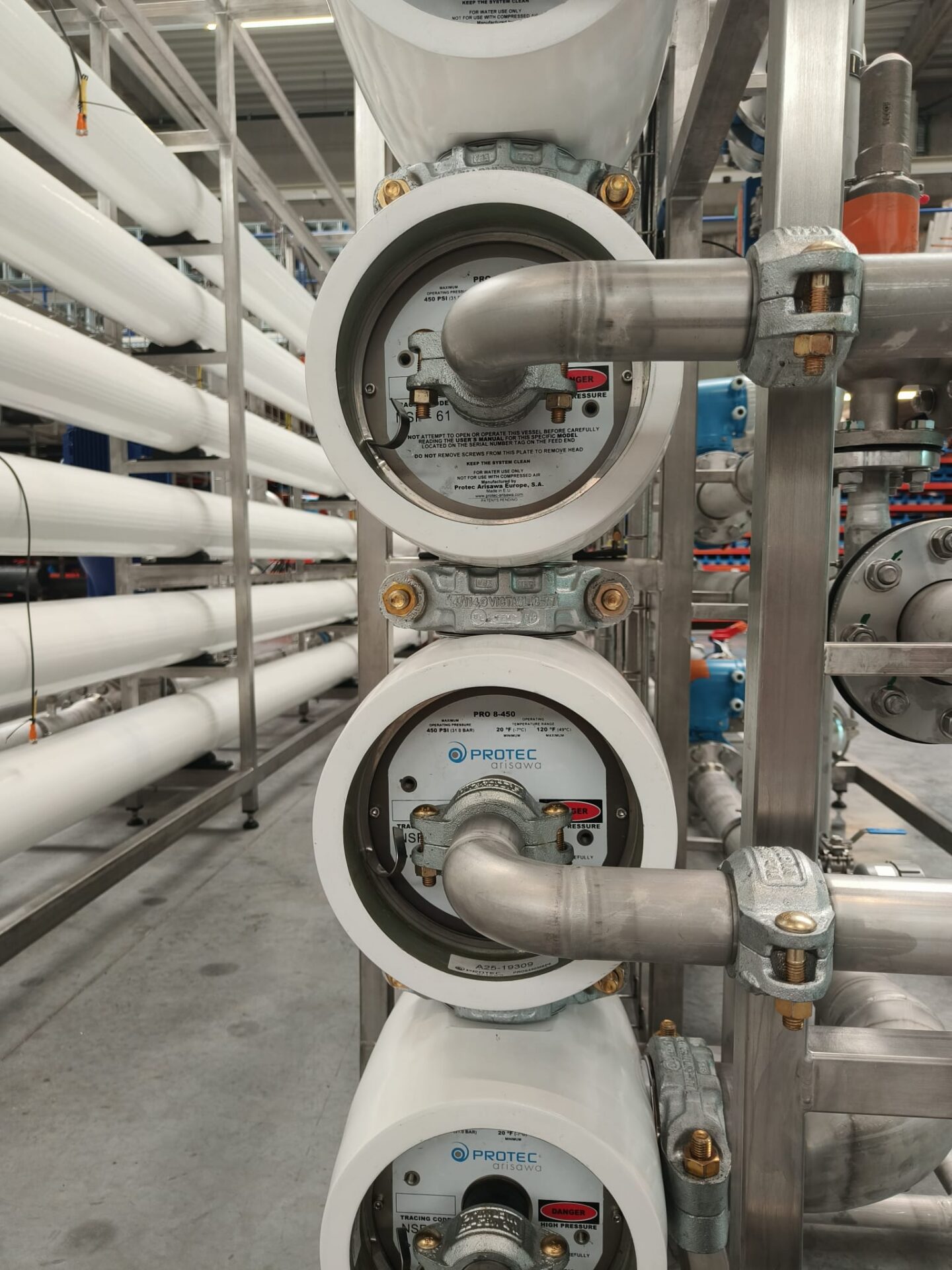
An industrial RO installation typically consists of a pretreatment system, dosing units, cartridge filters, a high-pressure pump, pressure vessels containing membranes, instrumentation and control systems, and often a permeate buffer tank or post-treatment unit. The feed water is first conditioned to protect the membranes. It then flows through the RO membranes, where it is separated into permeate and concentrate.
Depending on the application, the system can be designed in a compact and modular way. For higher flow rates or stricter quality requirements, the installation is often expanded further (e.g., multiple pressure vessels, additional polishing steps, etc.).
Applications of reverse osmosis in industry
Reverse osmosis (RO) is used across various industries to deliver consistent water quality and protect critical equipment. In the food and beverage industry, RO helps control process water quality. Power plants use RO for boiler feed water and as pretreatment for EDI (electrodeionization) or ion exchange systems. RO also plays a key role in the chemical, pharmaceutical, and electronics industries, where low conductivity, low salt content, or reliable process quality are required.
Thanks to reverse osmosis, companies can meet strict quality standards while extending the lifespan of their installations.
E.ON Power Plants Belgium
Ekopak installed a water treatment installation for E.ON Power Plants Belgium, including a water softener, reverse osmosis, electrodeionization, a resin filter, and a buffer tank.
More information can be found in our customer case study on E.ON Power Plants.
Benefits of reverse osmosis (RO)
A properly designed RO installation offers several advantages:
- High water quality: RO effectively removes a large proportion of salts, minerals, and other dissolved substances.
- Equipment protection: Lower salt and hardness levels help reduce scaling, corrosion, and fouling in downstream processes.
- Support for water reuse: RO can contribute to process water reuse and reduced discharge volumes, provided concentrate management and energy consumption are properly considered during design.
- Consistent performance: Continuous monitoring of flow rate, pressure, conductivity, and pH helps detect deviations at an early stage.

Different types of reverse osmosis
Not all RO systems are the same. The right configuration depends on the feed water quality, desired permeate quality, required recovery rate, and the intended application.
Single Pass RO (SPRO)
In a single pass RO installation, water passes through the membranes once. This setup is suitable for many industrial applications requiring stable, high-quality water, such as process water, rinse water, or pretreatment for additional polishing.
Double Pass RO (DPRO)
In a double pass RO installation, the permeate from the first RO stage is passed through a second RO stage. This achieves lower conductivity and higher purity levels. It is used in applications requiring very pure water, particularly in industries with strict quality standards.
Other variants
In addition, several design variations can be applied to the above configurations, such as single-stage or multi-stage RO, concentrate recirculation, high-recovery configurations, energy recovery systems, and more.

Maintenance of an RO installation
An RO installation performs optimally when it is properly maintained. Regular maintenance helps prevent membrane fouling and ensures consistent water quality.
Key maintenance aspects include:
Inspection and replacement of prefilters
Removing dirt, sand, and other particles before the water reaches the membranes.
Cleaning of RO membranes
Periodic chemical cleaning (CIP) to remove scaling, biofilm, and mineral deposits.
Monitoring of system parameters
Continuous monitoring of pressure, flow rate, conductivity, and pH to detect deviations at an early stage.
Preventive measures
Proper use of antiscalants and disinfectants to minimize scaling and biological fouling.
Proper maintenance extends the lifespan of the system, reduces unexpected downtime, and ensures that your RO installation consistently delivers water that meets the required quality standards.
At Ekopak, we design, install, and maintain reverse osmosis systems fully tailored to the specific water needs of our customers. Our solutions combine pretreatment, high-quality membranes, and monitoring systems to provide reliable water quality with minimal operational costs.
Would you like to learn more? Feel free to contact us at info@ekopakwater.com.