
Ekopak offers the techniques and methods required to ensure optimum water quality at all times. Tailored to the quality of the feed water and the customer’s requirements, we supply the right chemicals, disinfection methods, and customized water treatment equipment.
Custom water treatment equipment
With our expertise in industrial water treatment, we deliver tailor-made solutions for every industrial water application. Our focus is strongly on membrane filtration, with particular expertise in reverse osmosis (RO) and ultrafiltration (UF), two core technologies for high-quality industrial water treatment.
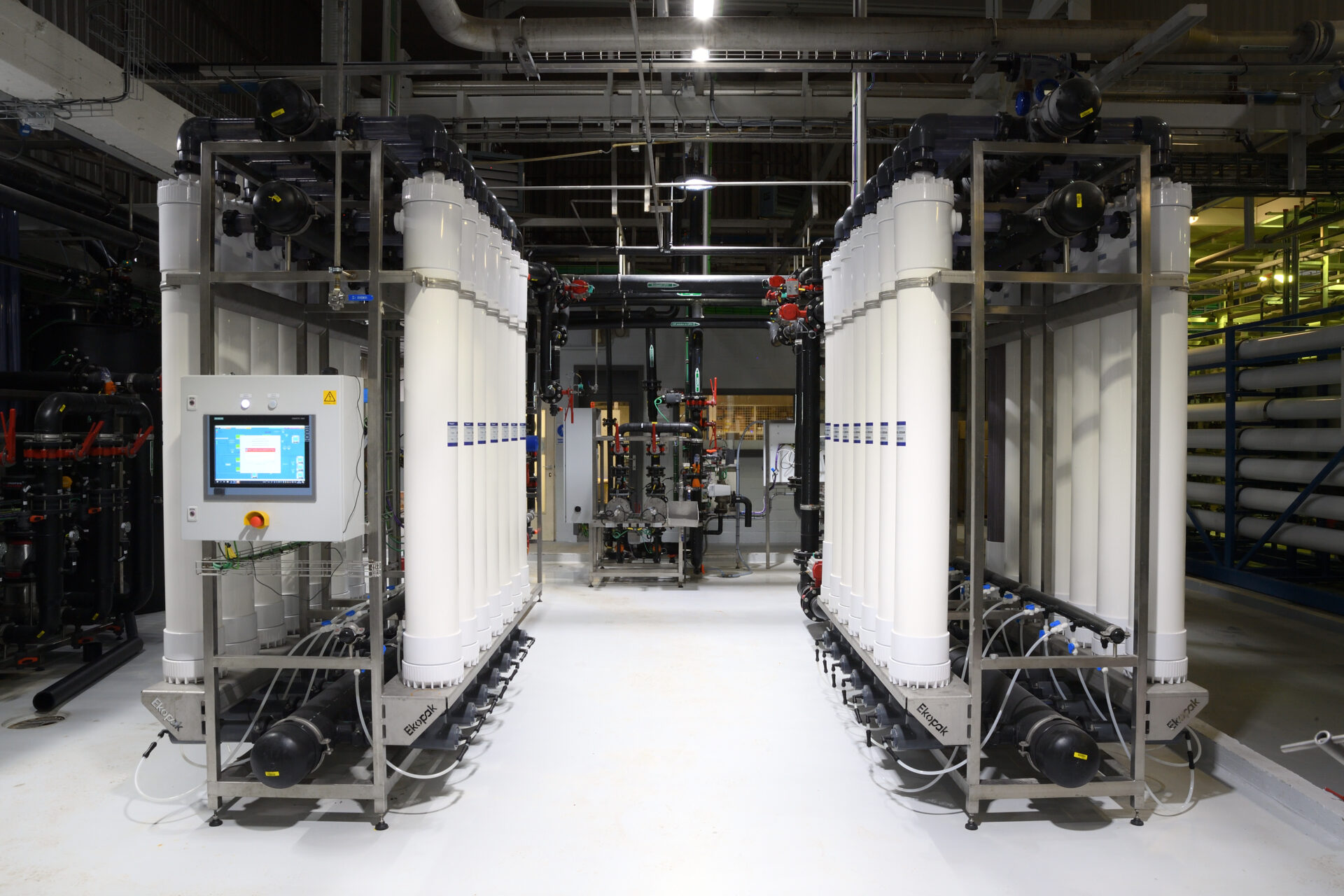
Ultrafiltration (UF)
Ultrafiltration is a membrane filtration process with a pore size of approximately 0.02 µm. It efficiently removes suspended solids, colloids, bacteria, and viruses from water.
The produced water has a low SDI (Silt Density Index), typically < 3, making it highly suitable as pre-treatment for a reverse osmosis (RO) system. UF therefore protects downstream systems and increases the overall reliability of the water treatment process.
Reverse Osmosis (RO)
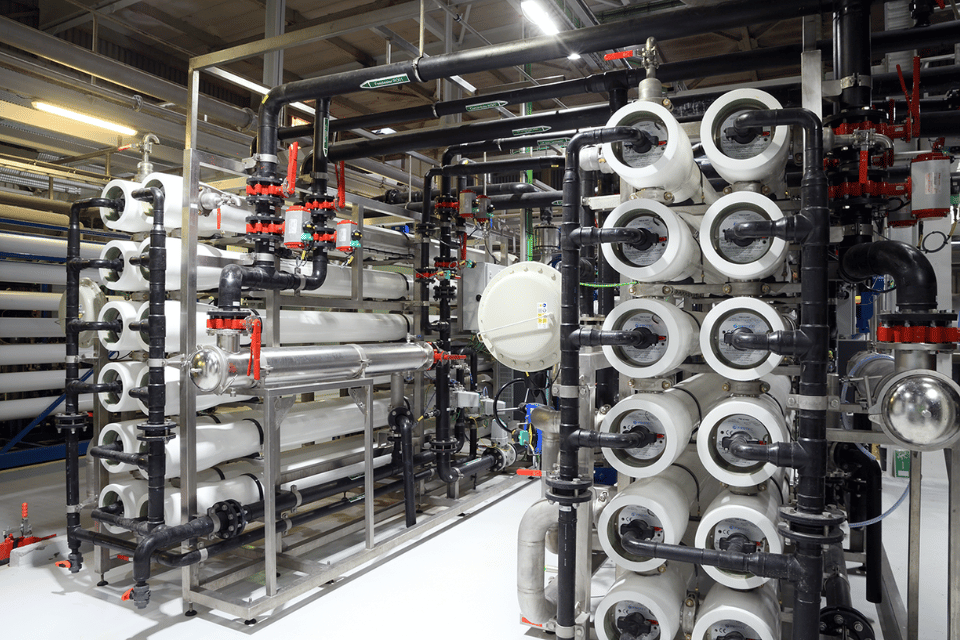
Reverse osmosis is a membrane filtration technology used to remove dissolved salts, organic compounds, and other micro-contaminants from water.
It is the most widely used technique for water demineralization in industrial applications and is used to produce high-purity water. In addition, RO is also applied in processes where the concentration of dissolved substances is required, such as in the food and process industries.
In addition, we handle the design, execution, and optimization of the following installations:
- Filtration units: bed, micro and Nano filtration
- Dosing stations: time, volume, or quality control
- Activated carbon filtration: adsorption of chlorine and organic substances
- Spraying systems: time, volume, or quality control
- Disinfection units: chlorination, UV, ozone
- Water softeners
- Online monitoring: acidity, conductivity, free chlorine, turbidity, flow rate, pressure, etc.
- Decarbonization
- Demineralization with ion exchangers
- Iron and manganese removal
- Physico-chemical and biological wastewater stations
Chemical water treatment
Our service engineers visit your company regularly to carry out analyses, and to advise and guide you in the pursuit of optimum water quality. We also supply and monitor the appropriate chemicals for internal water treatment.

Furthermore, we offer a wide range of treatment products for boiler, cooling, and other systems. These services and products can be combined with our 24/7 service for all purchased and customer-owned equipment.
Chemical water treatment is crucial for the efficient and reliable operation of industrial installations.
Ekopak offers chemical products for the following applications:

Steam boilers
Ekoboil
In steam boilers, chemicals such as oxygen scavengers, pH regulators, and deposit inhibitors are used to protect pipes and heat exchangers.

Cooling towers
Ekocool
In cooling towers, the primary focus is on controlling corrosion, deposits, and biological contamination through the use of biocides, dispersants, and corrosion inhibitors.
RO installations
Ekochem RO
In RO installations, chemicals such as anti-scalants are used to prevent mineral deposits (scaling) on the membranes.
Wastewater treatment installations
Coagulants, flocculants, antifoam
Chemicals help purify water and safely return it to the environment. Coagulants and flocculants make fine particles clump together for easy removal, while pH regulators and disinfectants maintain water quality and hygiene.
Condenser Passivation
Do you have a new condenser? Then, passivation is crucial to extend its service life and prevent corrosion. Without treatment, white rust can form, a sign that the protective zinc coating is beginning to dissolve. With a targeted passivation treatment, a durable zinc phosphate layer forms on galvanized surfaces, providing long-lasting protection. This process significantly extends the lifespan of your coil.

Disinfection methods
Today water disinfection is a must in many sectors. From drinking water to water for industrial applications, Ekopak offers a wide range of methods to disinfect your water. Following a thorough analysis of your requirements, we eliminate all pathogenic organisms using the appropriate technologies and products.
We also provide a complete solution against legionella and other types of microbiological contamination.
A. Chemical
- Chlorine dioxide
- Hydrogen peroxide
- Ozone
- Free chlorine
B. Mechanical
- Ultra filtration
- Nano filtration
- UV
C. Mechanical and chemical combined
- AOP advanced oxidation proces
FAQ
Ultrafiltration is a membrane filtration method that removes fine particles, bacteria, and viruses from water. Ultrafiltration uses membranes with very small pores for extremely precise filtration. It is a commonly used pretreatment for reverse osmosis.
Reverse osmosis is a membrane technology that removes most dissolved salts, minerals, and other contaminants from water. The water is forced through a semipermeable membrane under high pressure. It is the most widely used technique for demineralizing industrial water. RO is also used to concentrate dissolved substances.
UF removes particles, bacteria, and viruses. RO also removes dissolved salts and micropollutants. UF often serves as a pretreatment that protects RO membranes.
Ekopak supplies chemicals for steam boilers, cooling towers, RO systems, and wastewater treatment plants. These include oxygen scavengers, pH adjusters, anti-scalants, biocides, coagulants, and more. Our service engineers conduct on-site analyses to advise customers on the best solution.
Ekopak uses chemical methods (chlorine dioxide, hydrogen peroxide, ozone, free chlorine) and mechanical methods (ultrafiltration, nanofiltration, UV) for water disinfection. These can also be combined.
Preventing Legionella is of crucial importance. Ekopak offers a comprehensive solution against Legionella and other microbiological contamination. This includes monitoring water quality, implementing appropriate disinfection methods—such as chemical or thermal disinfection—and maintaining optimal water temperatures to prevent the growth of Legionella.