

Water is a crucial resource in industrial processes. At the same time, companies are increasingly facing stricter environmental regulations, higher quality requirements for process water and a growing focus on water reuse. Nanofiltration offers an efficient and sustainable solution to address these challenges.
This membrane technology selectively removes dissolved substances from water and, for many industrial applications, provides the ideal balance between ultrafiltration and reverse osmosis.
What is nanofiltration?
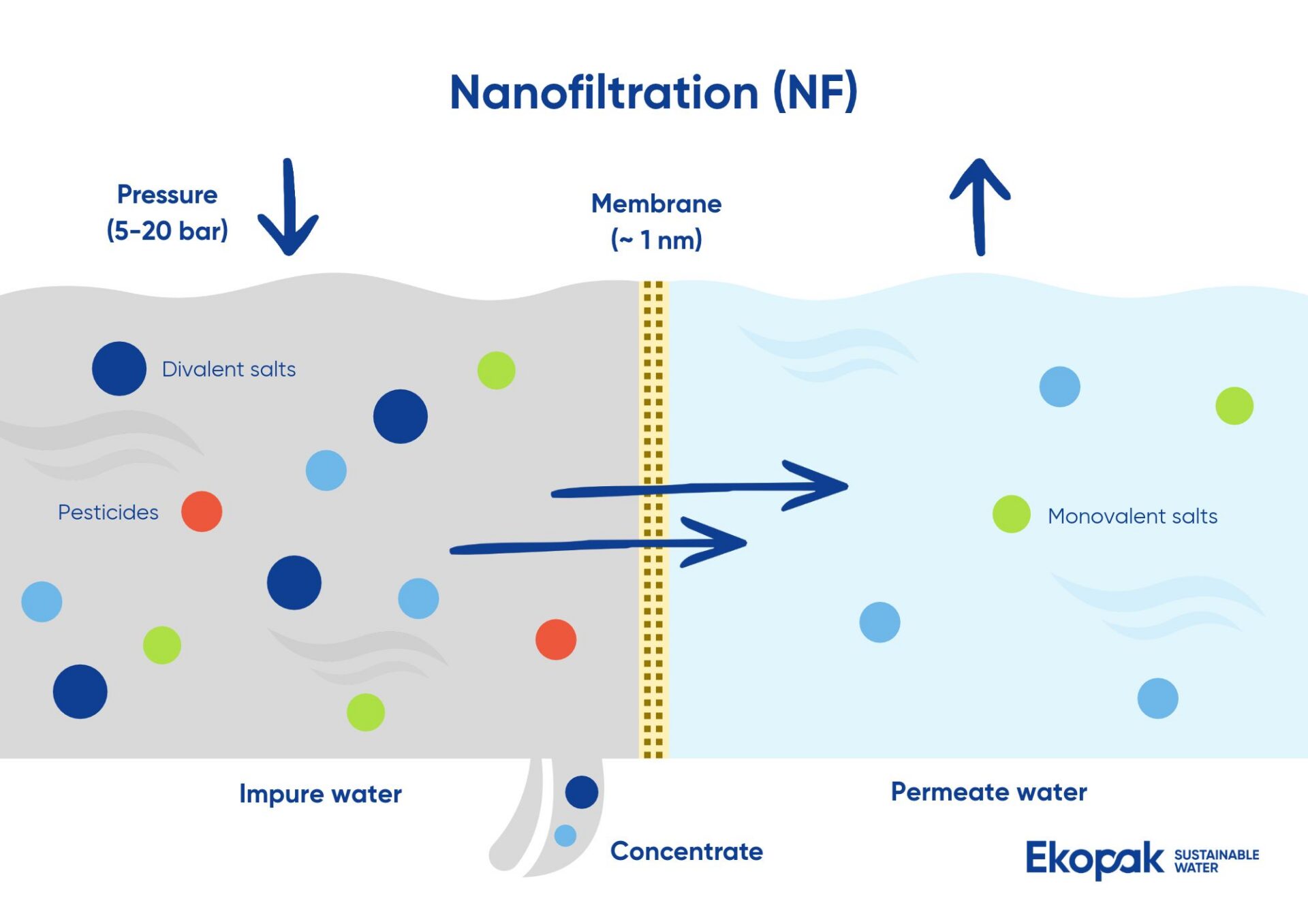
Nanofiltration (NF) is a pressure-driven membrane technology that sits between ultrafiltration (UF) and reverse osmosis (RO). The membranes have pores on the order of approximately 1 nanometer and typically operate at pressures between 5 and 20 bar, depending on the application.
This allows specific dissolved substances to be removed from the water while retaining some monovalent salts, such as sodium.
Nanofiltration is particularly well suited for removing:
- Divalent salts such as calcium and magnesium
- Organic compounds
- Pesticides
- Dyes
- Other dissolved contaminants
As a result, water quality can be significantly improved without the need for complete demineralization.
Why choose nanofiltration?
Not every industrial application requires demineralised water. In many cases, it is sufficient to reduce water hardness, organic load, or specific dissolved substances.
Nanofiltration offers an effective solution thanks to:
• Lower energy consumption than reverse osmosis
• Efficient removal of divalent salts
• Retention of some monovalent minerals
• Lower operating costs for certain applications
This makes nanofiltration an ideal balance between water quality, sustainability, and cost efficiency in many applications.
Ultrafiltration, nanofiltration and reverse osmosis: what is the difference?
| Ultrafiltration | Nanofiltration | Reverse Osmosis (RO) | |
|---|---|---|---|
| Pore size | ~ 0,01 – 0,1 µm | ~ 1 nm | < 0,1 nm |
| Operating pressure | 1 – 5 bar | 5 – 20 bar | 15 – 80 bar |
| Removes | Bacteria, particles | + divalent salts, organic compounds, pesticides, dyes | + monovalent salts (complete demineralization) |
| Energy consumption | Low | Medium | High |
| Typical application | Pretreatment, disinfection | Softening, process water, RO pretreatment | Demineralized water, drinking water from seawater |
Nanofiltration as a sustainable alternative to conventional water softening
Traditionally, water is softened using ion exchange resins. While this technology is effective, it requires regeneration with salt, resulting in chloride-rich waste streams.
Nanofiltration reduces water hardness without regeneration salts, thereby reducing its environmental impact. This can help companies meet increasingly stringent regulations on water consumption and discharge more easily.
EOC Group
At chemical manufacturer EOC Group in Oudenaarde, Ekopak uses nanofiltration in combination with reverse osmosis to convert groundwater into process and demineralized water.
By switching from individual softeners to a centralized, membrane-based installation, EOC Group reduced its water consumption for cooling by 25%. Since the softeners no longer require salt, the chloride load in the wastewater also decreased by 50 tons per year. Read the full EOC Group client case here.
How is nanofiltration used for process water?
For industries such as food and beverage, (petro) chemicals, pharmaceuticals, and other manufacturing environments, consistent water quality is essential for a reliable production process.
Nanofiltration can be used, among other things, to:
- Reduce the hardness of process water
- Lower salt concentrations
- Remove unwanted organic components
- Pre-treat water before reverse osmosis or other water treatment technologies
This helps protect installations against fouling and scaling, reduces maintenance costs, and maintains consistent process water quality.
What role does nanofiltration play in water reuse and circular water management?
More and more companies are investing in water reuse and circular water management to reduce their dependence on drinking water.
Nanofiltration plays an important role in this process. By selectively removing unwanted substances from treated wastewater or process water, water can be reused in industrial processes. This reduces both freshwater consumption and the amount of wastewater that needs to be discharged.
For companies pursuing sustainable water management, nanofiltration is therefore an important part of a circular water strategy.
Lower energy consumption than reverse osmosis
An important advantage of nanofiltration is its relatively low energy consumption. The technology operates at a lower pressure than reverse osmosis, which also results in lower energy consumption.
For applications where complete desalination is not necessary, nanofiltration therefore offers an excellent combination of water quality, energy efficiency and operating costs.
Looking for the right membrane technology?
The choice between nanofiltration, ultrafiltration and reverse osmosis depends on your water quality, process requirements and sustainability objectives.
At Ekopak, we analyze your water streams and are happy to advise you on the most suitable water treatment technology. Our installations can be fully customized and easily integrated into existing water treatment installations.
This ensures a solution that is technically, economically and sustainably optimized for your industrial application.